
PAUL EDWARDS: I am writing these lines in the midst of the strangest cricket season any of us will ever know...
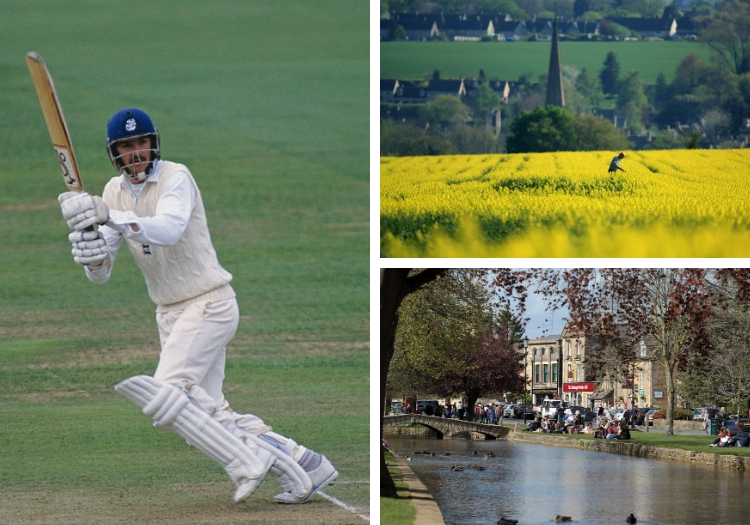

“Do you shoot at all, Paul?”
“Denis, I’ve never shot a live animal in my life.”
“Well, there’s not much bloody point shooting a dead one.”
Touché.
In the early 1980s I taught History for four mainly blissful years at Rendcomb College, a small school in the south Cotswolds. Gloucestershire’s postcard villages – Bourton-on-the-Water and all that crush – lay some 20 miles away but from my rooms on the top floor of the old mansion which housed the school’s main building I could look across the Churn valley, west to the village of Woodmancote, or north to Elkstone, where the poet P J Kavanagh lived.
It was a good half-hour’s walk to The Bathurst Arms, and Cirencester was another five miles distant. There was an Irish invasion every March and the other Cheltenham Festival was an even greater delight. I was a town boy who had fetched up in the middle of the countryside. Perhaps it was not surprising that those four years changed my life.
But of course it is people who really make the difference. For a school which had around 260 pupils and admitted girls in the sixth form Rendcomb turned out some good cricket teams. That it should have been so was partly due to facilities: “Up Top”, the playing fields, accommodated about five matches on good pitches with some ease.
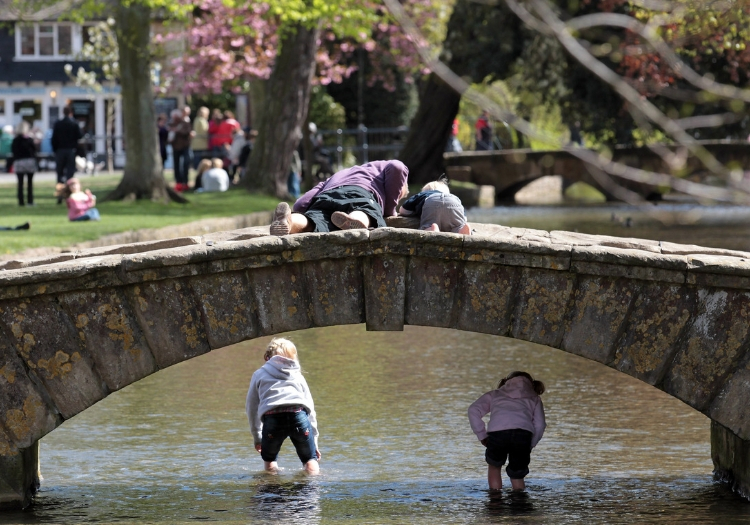
Bourton-on-the-Water
But I soon discovered that the seriousness with which the game was taken also reflected the commitment of the school’s groundsman, who was also the keenest and most natural coach I have ever known. After I was made master-in-charge of cricket at the end of my first year it was rare for a couple of days to pass without us having a conversation about the school’s teams or who had taken our attention in the first-class game. Whether the boys he coached recall their afternoons with David Essenhigh is something I expect never to know; but I remember him.
He was a small, deep-chested man who carried the permanent tan of someone who spent most of their working day in the open air. But in contrast to the reticence frequently characteristic of groundsmen, David was positively gregarious, even if you had to prove you knew something about cricket to earn his full respect. Once he realised my love of the game matched his own he was difficult to keep away – but then I rarely wanted to.
My only regret was that I didn’t question him more deeply about his early career, which had included at least 85 Minor County championship games for Wiltshire. What I did discover was that he was born in Folkestone in 1936 and that he had nurtured some hopes of playing for Kent. But neither as an opener nor as an off-spinner was he ever quite of first-class standard and he told me Colin Cowdrey had advised him to try coaching. That changed his life, too.
"That horse was balanced on its penis and you rescued it"
To see him running a coaching session was to see a man in perfect concert with his world. It didn’t matter to him if his pupils were talented boys or novice members of staff looking to gain their first badge. He encouraged them all and managed to tailor his advice to their specific requirements. I wonder if it ever occurred to my colleagues in the staff-room that one of the most gifted teachers at their school was the bloke who cut the grass.
As soon as anybody showed a keenness to play cricket David was their friend. The “bloody Bursar” who blighted his life with crackpot economies during morning break became the recipient of his kindly encouragement during a Staff match on the same evening. “Well bowled, Edward!” he would enthuse should the ball bounce only once on its way to the wicketkeeper.
But in truth both David and I had to work hard to feel at home among Gloucestershire’s gentry. One evening the entire staff were invited for drinks with one of the governors and his wife. We attempted to make small talk about A Levels, pastoral care and horse trials but were failing dismally. “I think we could all do with some food,” said the lady of the manor. “Can you bring some, darling? The smoked salmon is under the Canaletto.”
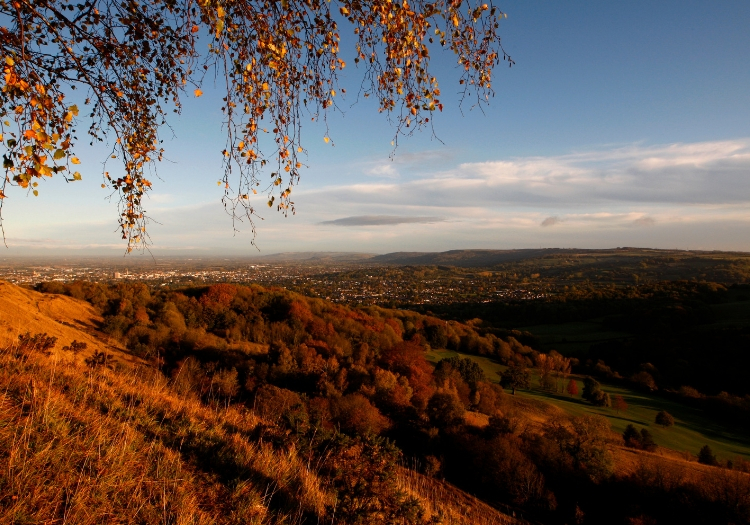
Leckhampton Hill in the Cotswolds
On another occasion we were playing five-a-side football in the gym when someone rushed in.
“Come quick! We need help! The horse!”
Bemused and alarmed, we rushed down to the yard where the hubbub was coming from and found the said horse with its front legs and much of its body out of its stable and the remainder trapped within. The top half of the door had been left open, thus encouraging this failed bid for liberty but the result was that the beast was now in loud distress. Without thinking too much about the consequences – the Health and Safety gauleiters would have a fit today – another master, two sixth-form boys and I grabbed the front legs of the horse and heaved it back inside. The headmaster’s wife, who was something of an equine obsessive, was appropriately grateful at a drinks party a couple of days later.
“Thank you so much, Paul! That was terribly brave!”
“Not at all. I had lots of help and we sorted things pretty easily.”
“Nonsense,” boomed the reply. “That horse was balanced on its penis and you rescued it.”
“Oh, I’m sure it’ll do the same for me one day.”
Rendcomb’s cricket mattered very much to David but he was also well connected around the county and, although nearing fifty, he still played occasionally for Cirencester. Tom Graveney and also Graham Wiltshire, the Gloucestershire coach, were good friends of his and there was always a particular light in his eye when he thought he had seen someone with the sort of quality even he could not coach.
"I wonder if it ever occurred to my colleagues in the staff-room that one of the most gifted teachers at their school was the bloke who cut the grass"
One evening when we were travelling by minibus to a Staff match he told me that he’d spotted a young cricketer who he absolutely knew was going to make it in the professional game. “He’s got the ability, of course,” said David. “That’s obvious to anyone with half an eye. And he’s also got it up here,” he added, tapping his head.
"But the thing is, he’s got it here,” and he pointed not to his heart but to the middle of his torso. I took that to mean that there was some essential quality about the young lad – it was more than guts – that wouldn’t be satisfied unless he made it as a professional cricketer. It was more than will, more than character.
A few months later I realised how astute David’s judgement of Jack Russell had been. And when I watched my old friend coach in the school nets those blue afternoons – it never rained, of course – I thought a kindred judgement could be applied to him. And when I sit in press boxes during Test matches or on that famous media balcony during the Cheltenham Festival I sometimes think of David and he teaches me, still.
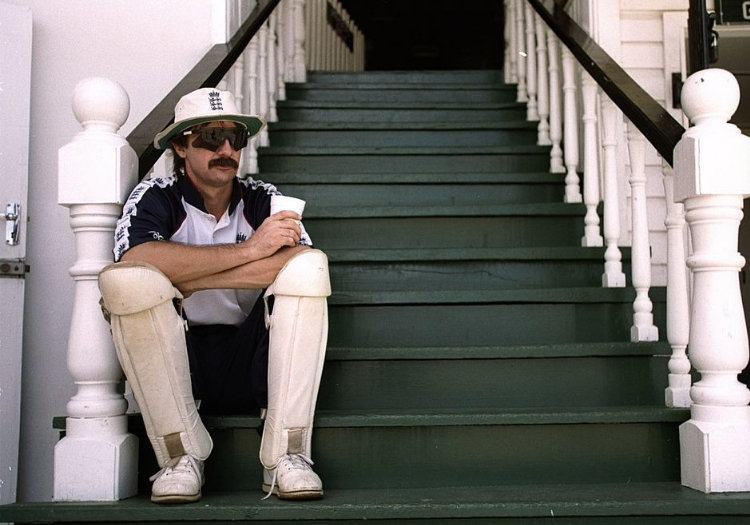
Jack Russell
It is over thirty years since I left Rendcomb. The school is much changed now and I have only been back twice, the last occasion being in 2014, when Worcestershire beat Gloucestershire inside three days at the College Ground and I made the most of a rare day off. I visited the Bathurst and then strolled up to North Cerney’s ground, which I still think one of the most beautiful in the land. A buzzard circled in the warm air and a harvester cruised silently up and down a distant field of wheat. I looked across at Rendcomb.
Brideshead.
I am writing these lines in the midst of the strangest cricket season any of us will ever know. Outside my flat the occasional supermarket lorry rumbles past. Otherwise the main drag from Birkdale into Southport is sepulchre-silent. This spring is a riot of poignancy; every bud and blossom seems to mock the absence of cricket. It is an April unlike any other.
And yet I do not have to close my eyes to be back in my rooms at Rendcomb. Very soon I will hear a busy step on the wooden corridor outside. In a moment there will be a brisk knock on the door. Then a weather-blessed, bright-eyed face will appear, asking me why I haven’t got the kettle on and whether we should push young Bailey up to number three.

Welcome to www.thecricketer.com - the online home of the world’s oldest cricket magazine. Breaking news, interviews, opinion and cricket goodness from every corner of our beautiful sport, from village green to national arena.