
JAMES COYNE: As there’s little hope of the schedule easing up, maybe it’s time to add more umpires to the elite panel, or do away with the demand for neutrality
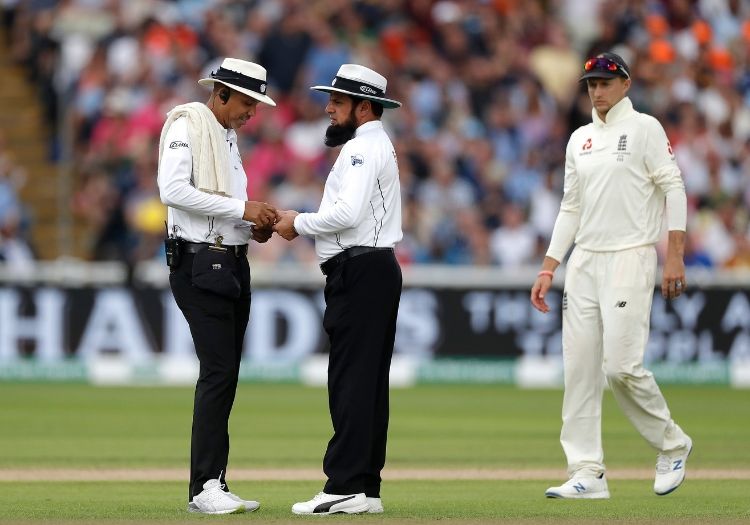
They talk about player burnout. But what about umpire burnout?
In this Ashes they are using the 2017-issue Dukes ball – with its more pronounced seam than the 2019 ball being used in the County Championship – in the hope that it will summon up enough of Australia's nightmare collapses from the 2015 series. (And, to be fair, Stuart Broad did reprise his Edvard Munch 'hand over his mouth' scream when Tim Paine picked out square leg.)
Add in the haze floating around Edgbaston, that forced the floodlights to be turned on just before tea, then place the ball in the hands of a practitioner as skilled as Broad, not to mention Chris Woakes… and plenty was going off out there. Just imagine if Jimmy Anderson had bowled more than four overs.
Not easy for the batsmen. Not easy for the umpires either.
The ICC has just rejigged its elite panel for the 2019/20 season. Out go Ian Gould, who has retired, and S Ravi. In come Joel Wilson from the West Indies and Michael Gough of England.
Only five of the 12 men on the elite panel are actually eligible to stand in an Ashes series, due to the requirement for neutral umpires. The two standing here for these five (ha!) days are Aleem Dar from Pakistan and Wilson from the West Indies; New Zealand’s Chris Gaffaney is TV umpire. The others are Marais Erasmus and Kumar Dharmasena. With S Ravi dropping off the panel, there are no Indians; nor are there any Bangladeshis, Zimbabweans, Irish or Afghans.
As a Pakistani, in a market where England, India and Australia play more Tests than any other side, Dar is in particularly high demand. Since October 2018, beginning with all three England Tests in Sri Lanka, Dar has umpired 23 top-level matches and been TV umpire in another 13. Seven and four of those were in the World Cup, around which world cricket’s finances revolve. No pressure there, then.
Then he stood in the Ireland Test, which wasn't exactly one of those soporific Ken Barrington run-fests of the 1960s. Wilson took charge of six games in the World Cup and was TV umpire in four.
Not Stakhanovite working hours, you might say. But, when you factor in all the travelling and staying away from home, it must take its toll. Without doubt the ICC do their best to share out the workload within the contours of the rules.
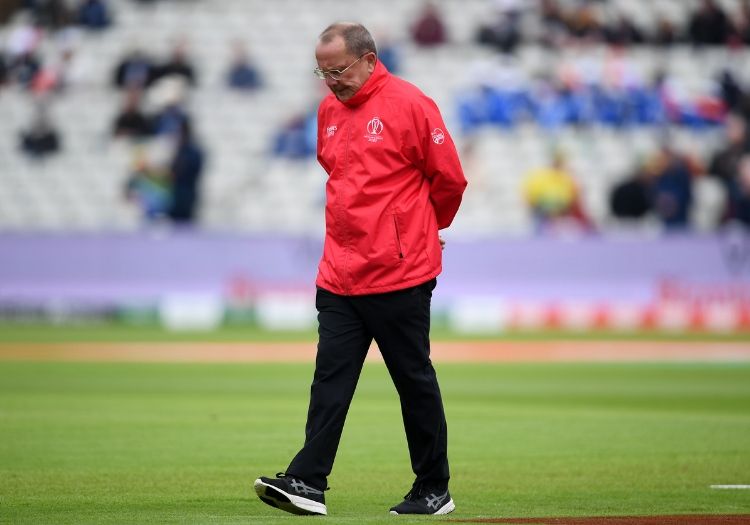
Ian Gould retired after the World Cup
But this was a bit of a struggle for Dar and Wilson for the first two sessions. At one stage of the opening day, in terms of big decisions than determined a batsman's wicket, between them they had called three of 10 correctly. There was little overt grumbling about this success rate in the stands at Edgbaston, since most of it was working to England's advantage. As if Dar’s day wasn't taxing enough, he was stung by a wasp in the evening session and drinks taken early.
It could just be a rare run of unfortunate misjudgements; or it could be symptomatic of something deeper.
Dar could be forgiven his first error, when David Warner escaped nicking one down the leg side off Broad, as his bat was quite close to the ground at the time, and it looked fairly innocuous on first viewing.
Both Warner and James Pattinson were given out by Dar to hooping deliveries from Broad which Hawk-Eye suggested were heading fractionally past leg stump.
Soon afterwards, Steve Smith shouldered arms and was given out by Wilson to a ball which looked to the naked eye as if it was hitting off stump. Hawk-Eye suggested not. Back Smith came, to play a truly great innings.
Usman Khawaja was initially reprieved by Wilson after nicking Woakes behind – an appeal about which England were utterly adamant. An lbw shout against Matthew Wade, turned down by Wilson, was shown to be hitting middle two-thirds of the way up.
Worst of all, Peter Siddle – already none too impressed at being required to bat at 3pm on the first day of a Test – got a chunky inside edge to the first ball of Woakes’ third spell. England went up, and Wilson gave him out. Not for very long, as luckily Australia still had one review left. Smith was frantically motioning the T-signal from the other end. By now, it goes without saying that we were keeping count of all these.
VISIT THE ASHES HUB
Personally, it jars to go into such forensic detail about umpires' decisions. It's bloody hard work out there, for a start. These men have reached this point through their excellence, through being the best in their own system back home. Maybe it's as much about us as it is them: a generation of TV replays has conditioned us to expect perfection in our officials, as if they are automatons. Maybe they need a little more support.
With the Dukes ball comes more action, and more pressure on the umpires to keep their concentration and judgement. If Test matches continue to take place at such breakneck speed, and Dukes are used more and more round the world, the ICC might soon have to think about expanding the panel, whatever the financial cost. Of course, there’s a point at which an elite panel no longer becomes elite if you have more than just the best on it.
So maybe there's another solution: do away with the neutrality element. The world has changed plenty since Imran Khan lobbied for the introduction of neutral umpires in the late 1980s; the game is regulated by the ICC; and we have TV replays and DRS to check every decision. Who, honestly, would question the integrity of these professionals anyway? And we already have one home umpire standing in bilateral limited-overs internationals.
Neither am I suggesting that English or Australian umpires are better than those from other countries, as some of the old English pros used to in years gone by. It's just that maybe the likes of Dar, Erasmus, Dharmasena and Gaffaney, so in demand for a considerable amount period now, could do with a bit more downtime.
There is such a thing called rest – and all human beings are in need of it from time to time, no matter how excellent they are.
All these things come back to the utterly saturated international calendar, and the boards' endless pursuit of money.
Meanwhile, we all somehow expect the standard of cricket to remain as high as it ought to be. Something, at some stage, has to give.
To celebrate England winning the World Cup you can subscribe to The Cricketer for just £20.19. Click here to learn more

Welcome to www.thecricketer.com - the online home of the world’s oldest cricket magazine. Breaking news, interviews, opinion and cricket goodness from every corner of our beautiful sport, from village green to national arena.